UK Speeding Fines Explained: Band A, B, and C Penalties, Points & Court Limits
Quick Answer: Under UK law, court-prosecuted speeding fines are determined by the Sentencing Council banding system based on recorded speed and relevant weekly income. Band A fines start at 50% of weekly income plus 3 points; Band B fines start at 100% plus 4–6 points or a 7–28 day ban; and Band C fines start at 150% plus 6 points or a 7–56 day ban. Maximum statutory fine caps are £1,000 on standard public roads and £2,500 on motorways.
Receiving an unexpected envelope with a police safety camera partnership crest triggers immediate stress for any UK motorist. Will you receive a £100 fixed penalty and three points? Can you avoid endorsements by taking a speed awareness course? Or has your recorded speed crossed into Magistrates' Court territory, exposing you to means-tested salary percentage fines and driving bans?
In England and Wales, court speeding fines are not fixed figures. Instead, magistrates must sentence drivers using a statutory banding framework established by the Sentencing Council. Here is the complete breakdown of how speeding bands operate, how your net weekly income determines your fine, the statutory caps that protect drivers, and the exact speed thresholds for offender retraining.
How Are Speeding Penalties Determined in the UK? (FPN vs Magistrates' Court)
Speeding offences in England and Wales follow a two-tier statutory enforcement pathway governed by the Road Traffic Act 1988 and the Road Traffic Offenders Act 1988. When an automated speed camera or police officer detects a vehicle exceeding the posted limit, the offence does not immediately trigger an arbitrary fine or court summons.
The Notice of Intended Prosecution (NIP) and Section 172 Requirement
Under Section 1 of the Road Traffic Offenders Act 1988, the registered keeper must be served with a Notice of Intended Prosecution (NIP) within 14 days of the alleged speeding violation. Attached to the NIP is a Section 172 requirement compelling the vehicle keeper to identify who was driving the vehicle at the exact time and location recorded.
Failing to complete and return this Section 172 driver nomination within 28 days constitutes a separate criminal offence under Section 172(3) of the Road Traffic Act 1988. This secondary failure carries a mandatory 6 penalty points and a fine of up to £1,000, which frequently results in harsher penalties than the underlying speeding infraction itself.
Fixed Penalty Notices (£100 + 3 Points) vs Single Justice Procedure (SJP)
For minor speeding infringements where the driver's speed falls just above the enforcement threshold, the police force may issue a conditional offer of a Fixed Penalty Notice (FPN). The standard UK fixed penalty is £100 and 3 penalty points endorsed on the driver's licence. Accepting an FPN resolves the matter without criminal court proceedings.
However, an offence is transferred directly to the Magistrates' Court via a Single Justice Procedure (SJP) Notice if:
- The recorded speed exceeds the statutory cut-off for a fixed penalty (typically Band B or Band C speeds).
- The driver already holds 9 or more active penalty points, meaning 3 additional points would trigger a 12-point "totting-up" disqualification.
- The motorist declines the conditional fixed penalty offer and elects to contest the allegation in court.
Under the Single Justice Procedure, a single magistrate sitting with a qualified legal adviser reviews the written evidence and financial means forms to calculate the statutory fine and endorsements.
The Sentencing Council Speeding Penalty Bands: Band A, B, and C
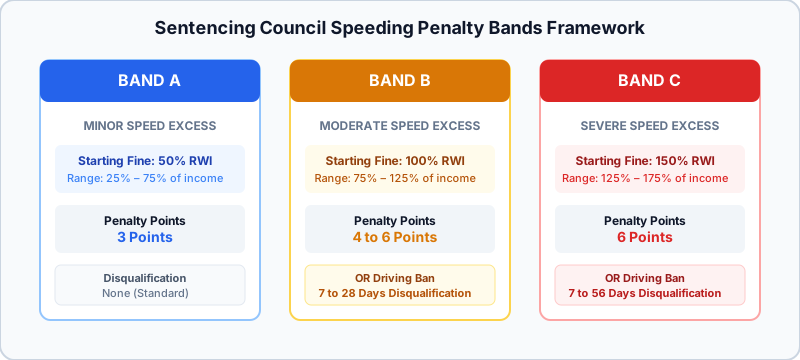
When a speeding charge reaches the Magistrates' Court, magistrates must adhere to the definitive sentencing guidelines published by the Sentencing Council for England and Wales. These guidelines classify offences into three primary sentencing bands—Band A, Band B, and Band C—linking the financial penalty directly to the offender's "relevant weekly income" (RWI).
Band A Speeding Penalties: Minor Excess (50% Weekly Income + 3 Penalty Points)
Band A represents the lowest category of court-prosecuted speeding offences. It applies when a vehicle exceeds the limit by a relatively modest margin (for instance, travelling between 31 mph and 40 mph in a 30 mph zone, or between 71 mph and 90 mph on a motorway).
The Sentencing Council establishes a financial starting point of 50% of the offender's relevant weekly income, with a sentencing range spanning from 25% to 75%. In addition to the fine, the magistrate will endorse the motorist's driving licence with 3 penalty points. Disqualification is virtually never imposed at Band A level unless exceptional aggravating conduct is present.
Band B Speeding Penalties: Moderate Excess (100% Weekly Income + 4–6 Points or 7–28 Day Ban)
Band B encompasses moderate to serious speeding violations where vehicle velocity substantially increases collision risk (such as driving between 41 mph and 50 mph in a 30 mph residential zone, or between 91 mph and 100 mph on a dual carriageway or motorway).
The financial starting point for Band B is 100% of the offender's relevant weekly income (one full week of net earnings), with an allowable sentencing range between 75% and 125%.
Crucially, the court faces a judicial fork in the road regarding endorsements: magistrates may impose either 4 to 6 penalty points on the driving licence OR order a discretionary disqualification ranging from 7 to 28 days. Under established sentencing principles, courts choose either points or a short-term driving ban—they do not combine both on a single speeding charge.
Band C Speeding Penalties: Severe Violations (150% Weekly Income + 6 Points or 7–56 Day Ban)
Band C addresses severe speeding infractions that represent an immediate threat to public safety (such as driving 51 mph or more in a 30 mph limit, 66 mph in a 40 mph zone, or 101 mph or more on a 70 mph motorway).
The starting point for a Band C financial penalty is 150% of relevant weekly income, operating within a statutory range of 125% to 175%. In addition to this substantial financial penalty, the court will either:
- Endorse the licence with 6 penalty points, or
- Disqualify the motorist from driving for 7 to 56 days (or until an extended re-test is passed in egregious cases).
If the recorded speed significantly exceeds the upper threshold of Band C (for example, driving over 115 mph on a motorway), magistrates possess discretionary statutory authority to extend the driving ban well beyond 56 days.
Extreme Speeding: Band D, E, and F Discretionary Offending
Where speeds reach extraordinarily dangerous levels—such as driving more than double the posted speed limit—magistrates may escalate sentencing into high-level discretionary bands:
- Band D: Starting point 200% of relevant weekly income.
- Band E: Starting point 300% of relevant weekly income.
- Band F: Starting point 500% to 700% of relevant weekly income, accompanied by immediate long-term disqualification.
In extreme circumstances, the Crown Prosecution Service (CPS) may bypass speeding charges entirely and prosecute the driver for dangerous driving under Section 2 of the Road Traffic Act 1988, carrying mandatory disqualification and up to two years' imprisonment.
Complete Speed Limit and Sentencing Band Matrix (20 mph to 70 mph)
The following reference matrix synthesises the operational guidelines from the National Police Chiefs' Council (NPCC) and the definitive sentencing tables from the Sentencing Council for England and Wales.
| Posted Speed Limit | Speed Awareness Course Eligible (NPCC) | Fixed Penalty Notice Range (£100 + 3 Pts) | Band A Penalty (50% RWI + 3 Pts) | Band B Penalty (100% RWI + 4–6 Pts / Ban) | Band C Penalty (150% RWI + 6 Pts / Ban) |
|---|---|---|---|---|---|
| 20 mph | 24 mph – 31 mph | 24 mph – 30 mph | 21 mph – 30 mph | 31 mph – 40 mph | 41 mph and above |
| 30 mph | 35 mph – 42 mph | 35 mph – 40 mph | 31 mph – 40 mph | 41 mph – 50 mph | 51 mph and above |
| 40 mph | 46 mph – 53 mph | 46 mph – 55 mph | 41 mph – 55 mph | 56 mph – 65 mph | 66 mph and above |
| 50 mph | 57 mph – 64 mph | 57 mph – 65 mph | 51 mph – 65 mph | 66 mph – 75 mph | 76 mph and above |
| 60 mph | 68 mph – 75 mph | 68 mph – 80 mph | 61 mph – 80 mph | 81 mph – 90 mph | 91 mph and above |
| 70 mph | 79 mph – 86 mph | 79 mph – 90 mph | 71 mph – 90 mph | 91 mph – 100 mph | 101 mph and above |
Note: Speeds below the enforcement threshold (such as 31–34 mph in a 30 mph limit) are generally subject to police discretion, vehicle calibration tolerance, or roadside verbal warnings, but remain technically unlawful.
How the Court Calculates Your Financial Penalty: Relevant Weekly Income (RWI)
Unlike fixed penalties, court-ordered speeding fines are means-tested. The court does not look at your gross annual salary; instead, it establishes your relevant weekly income (RWI).
Form MC100 and Determining Net Weekly Income
When you receive a Single Justice Procedure Notice or court summons, you are instructed to complete Form MC100 (Statement of Financial Circumstances).
Relevant weekly income is defined under the Sentencing Council guidelines as your net take-home pay after the statutory deduction of Income Tax and National Insurance contributions.
- Employed individuals: Calculate net weekly pay from recent payslips (e.g. monthly net pay × 12 ÷ 52).
- Self-employed individuals: Net profit divided by 52 weeks, following allowable business expenses and tax liabilities.
- Unemployed or non-earning drivers: If a defendant fails to provide financial details on Form MC100, the court presumes a default relevant weekly income of £440 per week (reflecting national median earnings estimates) and calculates the fine based on that presumed figure.
Early Guilty Plea Reduction (33% Discount), Victim Surcharge, and Court Costs
The final financial penalty payable comprises three distinct statutory components:
- The Fine: Starting point percentage of RWI adjusted for mitigating or aggravating factors. Under Section 73 of the Sentencing Code, entering an early guilty plea at the first procedural opportunity entitles the defendant to a mandatory one-third (33%) reduction of the fine. (Crucially, the early plea discount applies strictly to the financial fine—it does not reduce penalty points or the length of a driving ban).
- The Victim Surcharge: Under the Criminal Justice Act 2003 (Surcharge) Order, every court fine incurs a statutory victim surcharge. For motoring offences dealt with by magistrates, the surcharge is 40% of the ordered fine, capped at a maximum of £2,000.
- Prosecution Costs: The Crown Prosecution Service (CPS) applies for statutory court costs, standardly fixed at £85 to £135 for an uncontested Single Justice Procedure guilty plea, but rising significantly if the case proceeds to a full contested trial.
Worked Example: Band B Offence on a Typical Salary
Consider an employee earning an average UK net salary of £2,600 per month (£600 relevant weekly net income) caught driving 45 mph in a 30 mph zone (Band B offence):
- Base Band B Fine (100% RWI): £600
- Early Guilty Plea Discount (33% off): −£200 → £400
- Victim Surcharge (40% of £400 fine): £160
- CPS Prosecution Costs: £90
- Total Financial Obligation Payable: £650 (plus 4–6 penalty points endorsed on the driving licence).
Statutory Maximum Fine Caps (£1,000 General Roads vs £2,500 Motorways)
Regardless of an individual's personal wealth or astronomical weekly income, Parliament established absolute statutory caps on speeding fines under Section 17(2) of the Road Traffic Regulation Act 1984:
- General Public Roads (Single/Dual Carriageways, Urban Streets): The maximum allowable fine is £1,000.
- Motorways (M-designated highways and smart motorways): The maximum allowable fine is £2,500.
Even if a high-net-worth individual earns £20,000 per week, a Band C fine (150% RWI = £30,000) will be forcibly truncated by the court clerk to the legal maximum statutory ceiling of £1,000 or £2,500 before the early plea discount is factored in.
Speed Awareness Course Eligibility: The NPCC 10% + 2 mph Rule
Many motorists caught speeding avoid both penalty points and court appearances by attending a National Speed Awareness Course (NSAC), administered across the UK through the National Driver Offender Retraining Scheme (NDORS).
Qualifying Speed Bands for Course Diversion
The National Police Chiefs' Council (NPCC) publishes operational guidance standardising course eligibility. Police forces standardly offer a speed awareness course if the recorded speed falls between 10% plus 2 mph and 10% plus 9 mph above the posted speed limit:
- 20 mph limit: 24 mph up to 31 mph
- 30 mph limit: 35 mph up to 42 mph
- 40 mph limit: 46 mph up to 53 mph
- 50 mph limit: 57 mph up to 64 mph
- 60 mph limit: 68 mph up to 75 mph
- 70 mph limit: 79 mph up to 86 mph
The 3-Year Re-attendance Prohibition and Mandatory Police Criteria
You are legally barred from completing a speed awareness course if:
- You have completed any NDORS speed awareness course in the three years prior to the current offence date.
- Your recorded speed exceeded the upper 10% + 9 mph threshold (e.g. driving 43 mph in a 30 mph zone).
- The police officer or safety camera partnership determines that aggravated driving conditions (such as school zones during dismissal or severe weather) make course diversion inappropriate.
A speed awareness course costs between £80 and £120 depending on the regional police force provider, requires roughly 2.5 to 3 hours of online or classroom attendance, and results in zero penalty points on your DVLA record. While insurers cannot access the NDORS course database directly, drivers must answer truthfully if specifically asked during insurance renewal whether they have attended an offender retraining course.
Critical Motoring Rules: The 6-Point New Driver Revocation and "Totting Up"
Speeding penalty points do not merely increase motor insurance premiums—they carry direct legal triggers for total driving licence revocation.
Road Safety (New Drivers) Act 1995: The 2-Year 6-Point Rule
Under the Road Safety (New Drivers) Act 1995, anyone who passes their first driving test is placed on a strict two-year probationary period. If a newly qualified driver accumulates 6 or more penalty points within 24 months of passing their practical driving test, the DVLA will automatically revoke their driving licence.
This rule creates a catastrophic trap for young or novice motorists:
- Receiving a single Band B speeding conviction (4 to 6 points) can trigger immediate revocation.
- Accumulating two minor Band A speeding offences (3 points + 3 points) within two years results in mandatory revocation.
Unlike an ordinary court disqualification where driving privileges resume automatically after the ban expires, a revoked new driver reverts completely to learner status. They must re-apply for a provisional licence, drive only under supervision with "L" plates, and pass both the DVLA theory test and practical driving test all over again.
The 12-Point Totting-Up Disqualification and Exceptional Hardship
For experienced drivers outside their probationary period, accumulating 12 active penalty points within a rolling three-year window triggers a mandatory minimum 6-month driving disqualification under Section 35 of the Road Traffic Offenders Act 1988 ("totting up").
The only statutory mechanism to avert an automatic totting-up ban is to present an Exceptional Hardship argument in the Magistrates' Court. Under established case law:
- Mere personal inconvenience or loss of personal employment is generally insufficient, as hardships to the defendant are considered the ordinary consequence of repeated offending.
- The defence must establish that a disqualification would inflict severe, disproportionate hardship on innocent third parties—such as causing the bankruptcy of an employer, the direct redundancy of dependent employees, or leaving severely disabled family members without vital medical transport.
Frequently Asked Questions
What is a Band A speeding fine in the UK?
A Band A speeding fine is the entry-level court penalty for minor speeding offences, carrying a starting fine of 50% of the driver's relevant weekly income (within a 25%–75% range) alongside 3 penalty points endorsed on the driving licence. It applies to speeds such as 31–40 mph in a 30 mph zone or 71–90 mph on a motorway.
How much is a Band B speeding fine?
A Band B speeding fine carries a financial starting point of 100% of the driver's relevant net weekly income (one week's take-home pay, within a 75%–125% range). In addition to the fine, magistrates will order either 4 to 6 penalty points or a discretionary driving ban lasting between 7 and 28 days.
Does a Band C speeding fine mean an automatic driving ban?
No, a Band C speeding conviction does not result in an automatic driving ban, although disqualification is heavily considered. Magistrates possess the discretion to impose either a driving ban of 7 to 56 days OR endorse the licence with 6 penalty points, based on mitigating and aggravating road factors.
What is the maximum speeding fine on a UK motorway?
The maximum statutory fine for speeding on a UK motorway is £2,500 under Section 17(2) of the Road Traffic Regulation Act 1984. On all other non-motorway public roads (including dual carriageways and single-lane streets), the maximum statutory fine cap is £1,000.
How is relevant weekly income calculated for speeding fines?
Relevant weekly income is calculated from your net take-home earnings after statutory deductions for Income Tax and National Insurance, as reported on Form MC100. If an offender fails to disclose their earnings to the court, magistrates apply a default presumed income of £440 per week.
Can you get a speed awareness course for doing 40 in a 30 mph zone?
Yes, travelling at 40 mph in a 30 mph zone falls within the National Police Chiefs' Council speed awareness course eligibility window of 35 mph to 42 mph (10% + 2 mph up to 10% + 9 mph). Provided you have not attended a speed awareness course in the previous three years, you should qualify for a course offer.
Do speeding penalty points stay on your UK licence for 3 or 4 years?
Speeding penalty points remain legally active on your driving licence for 3 years from the date of the offence for totting-up calculation purposes, but they remain visible on your official DVLA driving record for 4 years before being automatically removed.
How long do you have to be caught speeding to lose your licence as a new driver?
Under the Road Safety (New Drivers) Act 1995, if you accumulate 6 or more penalty points within the first 2 years (24 months) of passing your practical driving test, the DVLA will automatically revoke your licence, requiring you to re-take both theory and practical tests.
Does an early guilty plea reduce speeding penalty points?
No, entering an early guilty plea reduces only the financial fine by up to one-third (33%) under Section 73 of the Sentencing Code. An early plea does not reduce the number of penalty points endorsed on your licence or shorten the duration of a court-ordered driving disqualification.
What is the victim surcharge on a UK speeding fine?
The victim surcharge is a mandatory statutory levy added to all court-imposed criminal fines in England and Wales. For motoring offences, it is calculated at 40% of the ordered fine amount, capped at a maximum of £2,000, and is used to fund victim support services.